

As a creator grows, the challenge is no longer just getting more fans. It is managing conversations, purchases, requests, content, and relationships at scale. This is where professional fan management becomes a major growth factor. Creators who want to build a sustainable business need structure, automation, and a clear overview of their entire community.
Why Fan Management Matters More Than Ever in 2026
Creators today rarely operate on just one platform. Many manage several accounts at the same time, publish content, answer messages, sell PPV content, run campaigns, and track revenue across multiple channels.
At the same time, fans expect fast replies, personal interactions, and consistent content.
What works manually with 50 or 100 fans quickly becomes difficult when an account grows to hundreds or thousands of contacts. Messages get missed, valuable fans are overlooked, and sales opportunities disappear.
Professional fan management therefore goes far beyond simply answering messages. It is about understanding fan behavior, organizing communication, tracking purchases, and building stronger long-term relationships.
What Professional Fan Management Really Means
Fan management includes every process that affects the relationship between a creator and their audience. This can include chats, sales, fan segmentation, content planning, purchase histories, and engagement data.
Successful creators do not treat every fan the same. They identify the difference between new followers, active buyers, loyal repeat customers, and high-value fans.
This makes it possible to create more relevant conversations and offers instead of sending the same message to everyone.
1. Segment Fans Based on Behavior
Segmentation is one of the most important foundations of modern fan management. Fans behave very differently. Some follow casually, others purchase frequently, while others respond especially well to direct and personal conversations.
Useful fan groups can include:
- new fans
- active buyers
- fans who have not purchased yet
- VIP fans
- inactive fans
- high-spending fans
- fans interested in specific content categories
Once fans are organized into useful groups, creators can communicate more strategically and deliver more relevant offers.
2. Prioritize Conversations Instead of Treating Every Chat the Same
One of the biggest fan management mistakes is giving every conversation the same priority. That may work for a small account, but it becomes inefficient at scale.
Successful creators prioritize conversations based on relevance. A fan who purchases regularly or is currently responding to an offer may need more immediate attention than someone who has been inactive for several weeks.
This allows creators and teams to focus their time where it has the greatest impact on revenue and fan retention.
3. Automate Repetitive Tasks
Automation has become one of the most important tools for creators in 2026. The goal is not to replace personal communication. Instead, automation should remove repetitive work so creators have more time for meaningful interactions.
Common areas for automation include:
- welcome messages
- follow-up messages
- content scheduling
- mass messaging
- recurring campaigns
- internal team tasks
The larger an account becomes, the more valuable these efficiencies become.
4. Understand Purchasing Behavior
Modern fan management is increasingly data-driven. The total number of fans matters, but understanding what those fans actually do is even more important.
Which content performs best? Which fans purchase repeatedly? Which messages lead to more conversions? Where do fans stop responding?
Creators who understand these patterns can optimize their offers and improve long-term revenue.
5. Keep a Central Fan History
Once a creator manages hundreds or thousands of fans, remembering every conversation and purchase becomes impossible.
A structured fan history can include:
- recent conversations
- previous purchases
- PPV content already purchased
- internal notes
- content preferences
- last activity
This makes conversations feel more personal even when a large number of fans are being managed at the same time.
Why Creator CRM Systems Are Becoming More Important
As a creator business grows, it quickly becomes a complex system of fans, conversations, content, revenue, and team workflows. Traditional social media dashboards are often no longer enough.
This is where creator CRM systems become valuable. A CRM can centralize fan information, conversations, activity, and internal workflows in one place.
Creators can quickly identify which fans are active, who purchased recently, and which users may be relevant for a particular offer.
Managing Fans Across Multiple Platforms
Many creators now use several platforms at the same time. While this can increase reach and revenue opportunities, it also makes management more complicated.
When every account has to be managed separately, creators and teams constantly switch between different dashboards. Messages, analytics, and sales data are spread across multiple systems.
A centralized workflow can reduce this fragmentation and make multi-platform creator businesses easier to manage.
How Famez Supports Fan Management
Famez is evolving from a marketing platform into a broader infrastructure for creators, agencies, and management teams.
The Famez CRM is designed to bring multiple creator workflows together in one environment. This includes areas such as conversations, content processes, team collaboration, analytics, and fan-related workflows.
The goal is to help creators manage multiple accounts and platforms more efficiently without relying on a different tool for every part of the business.
Team Management Becomes Essential at Scale
Large creator accounts are often no longer managed by one person alone. Chat teams, assistants, marketers, and managers may all work on the same business.
Without clear responsibilities, this can quickly become chaotic.
Who is allowed to answer messages? Who manages content? Who reviews performance? Who is responsible for campaigns?
For larger accounts, fan management and team management are closely connected.
The Most Common Fan Management Mistakes
Many creators lose revenue not because they lack fans, but because their processes are inefficient.
Common mistakes include:
- no fan segmentation
- sending too many generic mass messages
- not tracking purchase history
- slow response times
- missing follow-ups
- no central overview across multiple platforms
- unclear roles within the team
These issues usually become more serious as an account grows, which is why building structured processes early can be extremely valuable.
Stay Personal Even When Using Automation
Automation does not have to make communication feel robotic. In fact, good systems can create more time for meaningful personal interactions.
When repetitive tasks are handled efficiently and relevant fan information is immediately available, creators can respond more personally and understand individual fans more easily.
The key is to use technology as support rather than as a replacement for real communication.
Why Long-Term Fan Retention Matters More Than One-Time Sales
Successful creators do not focus only on individual transactions. A fan who returns regularly can be significantly more valuable than a one-time buyer.
Strong fan management therefore focuses on long-term relationships. Relevant communication, personalized interactions, and consistent engagement increase the likelihood that fans remain active over time.
Fan Management for Agencies
For agencies, the challenge becomes even larger. They may need to manage thousands of fans across multiple creators, teams, and accounts at the same time.
A centralized infrastructure can help standardize workflows while still allowing each creator to have an individual strategy.
Efficient systems can determine whether an agency can successfully scale from ten creator accounts to fifty or even hundreds.```
Fan Management in 2026 Is About Structure, Not Chaos
The creator economy is becoming increasingly professional. Reach alone is no longer enough. Successful creators and agencies are using structured processes, automation, analytics, and centralized tools.
Creators who organize their fan relationships effectively can respond faster, communicate more personally, and identify sales opportunities more easily.
Fan management is becoming one of the core building blocks of sustainable creator growth.
Manage Your Fans More Efficiently With Famez
Famez helps creators and agencies centralize workflows, manage multiple platforms, and build a more structured approach to fan management.
Useful Articles
-
 Sep 25, 2026
The Famez Creator Network: Discovery, Reach & Creator Business
The creator economy is more diverse than ever. Creators are active across different platforms, fans search by specific interests, countries, or creator types, and agencies need solutions for marketing, management, and growth.
-
 Sep 07, 2026
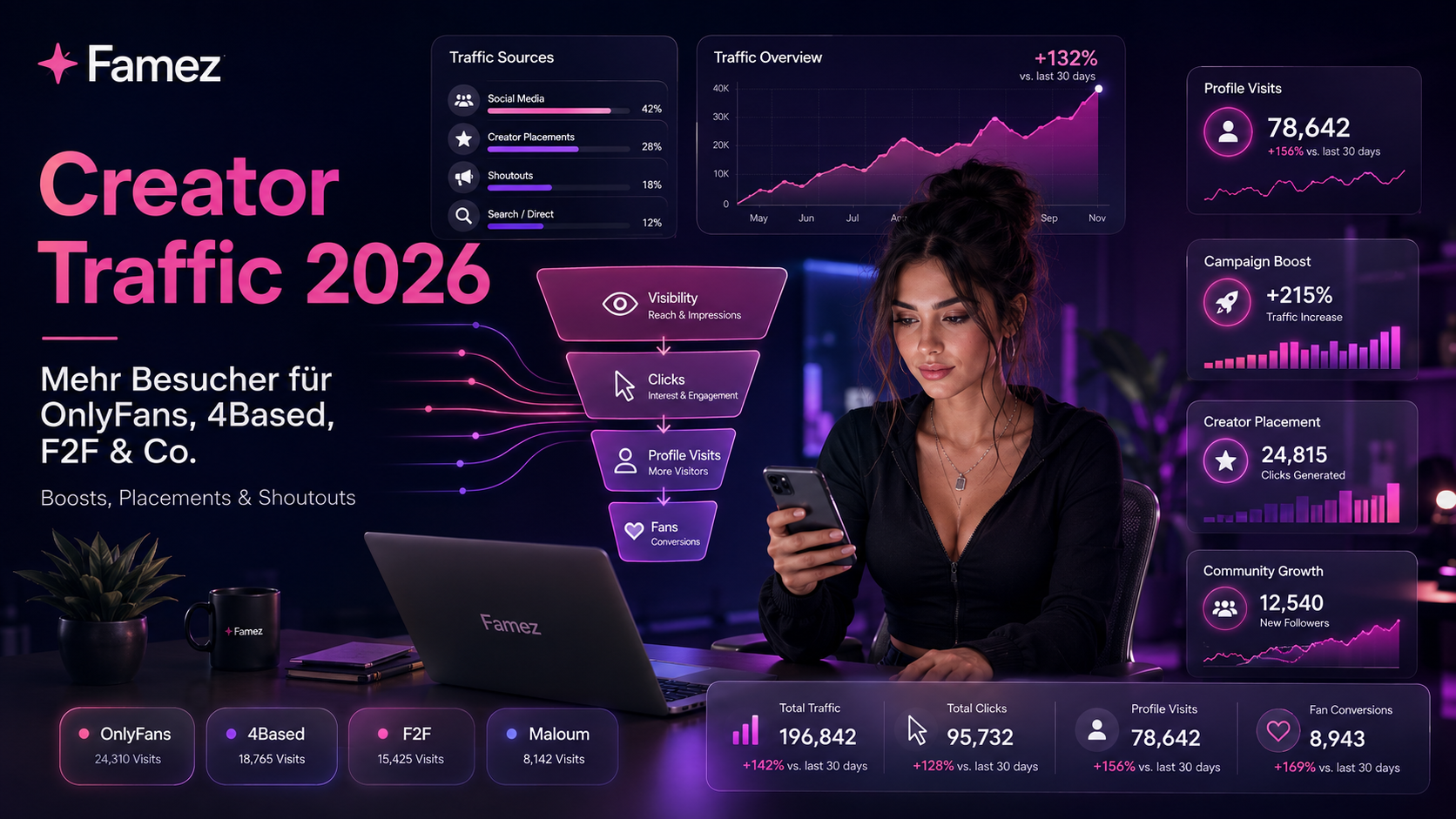
Creator Traffic 2026: Get More Visitors to OnlyFans, 4Based, F2F & More with Boosts and Placements
Great content alone is no longer enough in 2026. Creators can produce amazing photos, videos, and exclusive content, but if nobody discovers their profile, that content will not automatically generate new fans or additional sales. This is why traffic has become one of the most important foundations of a successful creator business.
-
 Aug 12, 2026
OnlyFans Marketing: The Most Important Strategies to Grow Your Reach
Successful OnlyFans marketing today involves much more than occasional social media posts and a link to your profile. Creators who want to build sustainable reach need a strategy that combines positioning, content, community, creator discovery, search visibility, collaborations, and targeted promotion.
Featured
-
Featured Free

-
Featured Free

-
Featured Free

-
Featured Free

-
Featured Free

-
Featured Free

-
Featured Free


Comments
Sign in to leave a comment.
No comments yet. Be the first to share your opinion!