

Creator CRM Guide 2026
Creator CRM 2026: Why Professional Creators Lose Time and Revenue Without a CRM
Many creators spend hours every day producing content, posting stories, answering messages, managing fans, and promoting their profiles. Yet growth often remains slower than expected. Not necessarily because the content is bad or because there are not enough fans, but because important business processes are not organized properly. This is exactly where a Creator CRM becomes valuable. In 2026, creators, agencies, chat managers, assistants, and creator teams need more than great content. They need structure, data, and clear workflows. This guide explains what a Creator CRM is, how it connects fan management, chat, PPV, content, analytics, and team operations, and why poor organization can cost both time and revenue.
Why Creators Are Becoming Businesses
A few years ago, many creators could build an audience by consistently publishing content, replying to fans, and promoting their profiles through social media.
Today, the creator economy looks very different.
Many creators now manage:
- Hundreds of messages and fan interactions
- Hundreds or thousands of fans
- Multiple creator platforms
- PPV offers and sales
- Mass messaging campaigns
- Stories and content calendars
- Advertising and promotional campaigns
- Social media channels
- Partnership opportunities
- Assistants, chat managers, or other team members
This no longer resembles a simple hobby.
It increasingly resembles a digital business.
Successful creators therefore build more professional systems around their work. They use tools, processes, and repeatable workflows that help them save time, understand performance, and prevent growth from turning into operational chaos.
One of the most important systems for this purpose is a Creator CRM.
A good CRM does not replace creativity, personality, or authentic fan relationships. Instead, it creates the organizational infrastructure that allows content, communication, monetization, marketing, and team operations to work together more efficiently.
What Is a Creator CRM?
CRM stands for Customer Relationship Management.
Traditional businesses use CRM systems to organize customer relationships, communication history, sales activities, opportunities, and important contact information.
The same principle applies to the creator economy, but the focus changes.
Instead of traditional customers, creators primarily manage fans, subscribers, buyers, and community members.
A Creator CRM brings important information and workflows together in one central environment.
Depending on the CRM and the connected creator platforms, this may include:
- Fan profiles and segmentation
- Message history
- PPV purchases and sales activity
- Campaign management
- Mass messaging
- Posts and content planning
- Story management
- Revenue and performance statistics
- Media organization
- Tasks and workflows
- Team roles and permissions
Instead of constantly switching between creator platforms, spreadsheets, notes, chats, and separate tools, a Creator CRM creates a more structured workspace for the entire creator business.
That is the real value of CRM: information is not simply stored. It becomes part of an organized workflow.
Creators and agencies who want to see how Famez approaches this can explore the Famez Creator CRM and its centralized infrastructure for modern creator management.
Why Creators Lose Revenue Without a CRM
Many creators initially assume that they do not need a CRM.
When there are only a few fans, conversations, campaigns, and sales processes to manage, that may work.
The situation changes quickly once the audience begins to grow.
When dozens or hundreds of messages, purchases, content tasks, and marketing activities happen every day, organization becomes a competitive advantage.
Missed Sales Opportunities
Imagine a fan showing clear interest in a premium PPV offer.
The conversation becomes buried beneath dozens of new messages.
Nobody remembers that the fan had already shown buying intent.
The follow-up never happens.
The sale may never happen either.
A CRM can help creators identify important fan activity, prioritize conversations, and create more systematic follow-up processes.
Lack of Visibility
Without structured data, many creators do not clearly know:
- Which fans purchase regularly
- Which fans are highly engaged
- Which fans have become inactive
- Which offers perform well
- Which PPV content generates the strongest response
- Which campaigns actually produce revenue
Without this information, business decisions are often based more on assumptions than real performance data.
Time Waste
Time is another major cost.
Where was the last conversation with that fan?
Who purchased the latest PPV offer?
Which mass message performed best?
Which content has already been used?
Which team member is currently responsible for which task?
The larger the creator business becomes, the more time can be lost simply searching for information. A centralized CRM reduces this operational friction.
The Biggest Organizational Mistakes in the Creator Business
Mistake #1: Trying to Remember Everything
With a small audience, memory may be enough.
As the community grows, it becomes increasingly difficult to remember fan interests, previous purchases, conversations, open tasks, campaign activity, and planned follow-ups.
Professional creator management therefore means moving important business knowledge out of individual memory and into structured systems.
Mistake #2: No Fan Segmentation
A brand-new fan, a long-term supporter, and a high-spending VIP fan do not necessarily have the same interests or expectations.
Treating every fan exactly the same limits personalization.
Segmentation allows creators to build different communication strategies for different groups.
Mistake #3: No Follow-Up System
Interested fans are often forgotten because conversations disappear underneath newer messages.
Without structured follow-up processes, creators may lose sales opportunities, reactivation opportunities, and valuable long-term fan relationships.
Mistake #4: Ignoring Data
Many creators know their total revenue but cannot always identify which specific activities produced that revenue.
Which campaign worked?
Which PPV price converted best?
Which fan segment responded most strongly?
Which content categories generated repeat purchases?
Without these insights, marketing and monetization become less efficient.
Fan Management as a Revenue Engine
Many creators invest enormous amounts of energy into acquiring new fans.
New reach matters, but significant growth potential often already exists inside the current community.
A Creator CRM can help creators:
- Identify VIP supporters
- Recognize high-value fans
- Prioritize highly engaged supporters
- Identify inactive fans
- Analyze buying patterns
- Understand fan interests
- Create more personalized communication
Fans generally do not want to feel like one anonymous entry in a massive database.
The better a creator understands which fans are loyal, active, or interested in specific offers, the more relevant communication can become.
A Creator CRM makes this type of fan management much more scalable as an audience grows.
Chat Management and CRM
Direct messaging is one of the most important areas of many creator businesses.
This is where creators build:
- Trust
- Personal relationships
- PPV sales
- Repeat purchases
- Fan loyalty
- Valuable audience feedback
However, this area becomes difficult to manage once message volume increases.
Messages get buried.
Interested fans are overlooked.
Follow-ups are forgotten.
VIP supporters may wait too long for a reply.
And when several chat managers or assistants are involved, another question appears: who is responsible for which conversation?
A CRM creates more structure and prioritization. Instead of treating every chat as an isolated conversation, interactions can become part of a longer-term fan relationship.
For creators with high message volume or growing teams, a Creator CRM for chat management can therefore make a meaningful difference in daily operations.
How CRM Can Improve PPV Performance
Pay-Per-View content remains an important monetization strategy for many creators.
Yet PPV offers are often distributed using a very simple approach: one piece of content, one message, as many recipients as possible.
A CRM enables a more structured strategy.
- Audience segmentation
- More personalized offers
- Purchase behavior analysis
- Evaluation of previous PPV performance
- More targeted follow-up campaigns
- Repeatable sales workflows
A fan who regularly purchases premium content can be approached differently from a new fan who has never purchased an additional offer.
Likewise, an inactive fan may require a different strategy than a highly engaged supporter.
The more relevant an offer is to the intended audience, the greater the potential for a positive response.
The goal is therefore not simply to send more PPV messages. The goal is to better understand which offers work for which fan segments.
Why Agencies Need CRM Systems to Scale
The operational challenge becomes even greater for creator agencies.
An agency may manage multiple creators, several platforms, different chat managers, individual content calendars, and multiple campaigns at the same time.
Without a centralized management system, questions quickly appear:
- Who is responsible for each creator?
- Which chat manager is handling which conversations?
- Which campaigns are currently running?
- Which tasks are still open?
- Which fans have already been contacted?
- Which team member has access to which areas?
A CRM creates greater transparency and clearer operational processes.
As an agency grows, it becomes increasingly important not to distribute critical information across separate messengers, spreadsheets, personal notes, and disconnected tools.
Through Famez for agencies, agencies can connect creator management, team workflows, CRM functionality, and additional Famez tools while also building their agency presence within the Famez ecosystem.
Creators remain in control of which agencies they work with and which areas are made available within the respective collaboration.
Creator With CRM vs. Creator Without CRM
| Without CRM | With CRM |
|---|---|
| Disorganized fan management | Centralized fan overview |
| Missed sales opportunities | Structured follow-up processes |
| Limited performance data | Better analysis of behavior and performance |
| Chaotic communication | Organized messaging workflows |
| Difficult scaling | Repeatable processes for growth |
| Unclear team responsibilities | Defined roles and permissions |
| Reactive decision-making | More data-driven decision-making |
| Higher operational stress | Greater visibility and control |
The difference becomes increasingly visible as an audience grows.
What works for fifty fans may no longer work for five thousand.
And what works for one creator can become impossible to manage manually when an agency is responsible for ten or twenty creators.
A CRM therefore provides one of the most important foundations for scaling: the ability to grow without automatically losing control.
How Famez CRM Supports Modern Creators
With the Famez Creator CRM, creators and agencies gain a centralized environment for important creator management and organizational workflows.
Famez follows a multi-platform approach. The exact functionality available can vary depending on the connected creator platform and its respective integration.
Potential Creator Use Cases
- Message management and 1:1 chats
- Fan management
- PPV management
- Mass messaging
- Posts and content planning
- Story management
- Campaign management
- Revenue and performance statistics
- Media organization through Famez Cloud
- Team roles and access permissions
- Multi-platform workflows
This allows areas that would otherwise be distributed across several tools and creator platforms to become part of a more unified workflow.
Collaboration is another important advantage. Creators can work with assistants, chat managers, account managers, or other team members and define clearer responsibilities.
Agencies can also organize several creators and teams more systematically, provided the respective creator has agreed to the collaboration and the required permissions are in place.
The CRM does not exist in isolation. It is part of the broader Famez creator economy ecosystem, which combines creator discovery, marketing, Famez Cloud, analytics, contract management, leak protection, and additional creator-focused tools.
Creators therefore remain free to decide how they want to organize their business: independently, with their own team, or together with a professional agency.
CRM Checklist for Creators
Want to know whether your creator business is already structured for growth? Use this checklist:
- ✅ Segment fans based on behavior and interests
- ✅ Organize important conversations and message history
- ✅ Track PPV offers and performance
- ✅ Measure campaign results
- ✅ Identify VIP and highly engaged supporters
- ✅ Recognize and reactivate inactive fans
- ✅ Define team roles and access permissions
- ✅ Plan posts and content systematically
- ✅ Organize media centrally
- ✅ Analyze revenue and relevant performance metrics
- ✅ Document important processes
- ✅ Standardize repeatable workflows
The more of these areas you can manage in a structured way, the easier it becomes to scale your creator business without losing control.
FAQ: Creator CRM Systems
What Is a Creator CRM?
A Creator CRM is a management system designed to help creators organize fans, conversations, content, campaigns, PPV activity, performance data, and team workflows from a more centralized environment.
Why Do Creators Need a CRM?
As an audience grows, communication, content, monetization, and team operations become more complex. A CRM provides greater visibility and helps organize important information and recurring workflows.
When Should a Creator Start Using a CRM?
A CRM can be useful early in a creator business. It becomes particularly valuable once fans are messaging regularly, PPV content is being sold, multiple platforms or campaigns are involved, or additional team members begin working on the account.
Is a CRM Only Useful for Agencies?
No. Individual creators also benefit from better organization, clearer fan management, and structured workflows. Agencies simply face additional complexity because they often manage multiple creators, employees, conversations, and campaigns at the same time.
Can a Creator CRM Increase Revenue?
A CRM does not guarantee higher revenue. However, it can help creators identify opportunities, improve follow-up processes, segment fans more effectively, understand buying behavior, and evaluate campaign performance. These insights can support better business decisions and help creators make more effective use of existing revenue opportunities.
How Does Fan Segmentation Help?
Different fans have different interests, engagement levels, and purchasing behaviors. Segmentation allows creators to build more relevant communication, content, and offer strategies for different groups.
What Role Does CRM Play in PPV Sales?
A CRM can help creators evaluate purchase behavior, identify relevant fan groups, track PPV performance, and build more structured follow-up workflows instead of sending every offer to every fan in the same way.
Can I Use Famez CRM Without an Agency?
Yes. Creators can use Famez independently. They can also invite assistants or other team members, or voluntarily choose to work with an agency.
How Does Famez CRM Support Agencies?
Famez supports agency workflows with centralized creator management, team roles, permissions, messaging, content, analytics, campaign management, and other tools designed for professional creator operations.
Is Famez Only a CRM?
No. Famez is a broader creator economy ecosystem. In addition to the CRM, Famez includes creator discovery, Famez Cloud, marketing, campaigns, analytics, agency tools, contract management, leak protection, and additional creator-focused features.
Conclusion: Growth Requires Structure
Many creators are constantly looking for the next platform, the next marketing strategy, or the next traffic source.
Those things matter.
At the same time, one of the biggest growth opportunities often exists much closer to home.
Inside the existing audience.
Inside previous conversations.
Inside existing performance data.
Inside better content organization.
And inside more efficient workflows.
A Creator CRM does not replace great content.
It does not replace personality.
It does not replace authentic communication.
And it does not replace creativity.
What it can do is provide the structure that allows those strengths to be used more professionally.
Creators who organize fans, manage messages more clearly, evaluate PPV and campaigns, define team roles, and build repeatable processes can scale with greater control.
That is why CRM systems are becoming increasingly important for professional creators and agencies.
The Future of Creator Management
The creator economy continues to become more professional.
Modern creators are no longer simply influencers.
They are entrepreneurs.
They manage communities.
They operate marketing campaigns.
They plan content production.
They analyze performance.
They build brands.
They work with assistants, chat managers, agencies, and external partners.
And increasingly, they use centralized systems to connect all these moving parts.
Whether you are an individual creator, a growing team, a professional chat manager, or an agency managing multiple creators, structure is becoming one of the most valuable assets in the creator business.
The goal is not automation for the sake of automation.
The goal is to reduce unnecessary operational work so that more time can be invested in content, community, strategy, and sustainable growth.
Build Your Creator Business Professionally
Want to bring fans, messages, PPV, content, campaigns, analytics, and team workflows together instead of managing them across disconnected tools and platforms?
Explore the Famez Creator CRM and discover how important areas of your creator business can be organized in a more centralized environment.
Useful Articles
-
 Sep 25, 2026
The Famez Creator Network: Discovery, Reach & Creator Business
The creator economy is more diverse than ever. Creators are active across different platforms, fans search by specific interests, countries, or creator types, and agencies need solutions for marketing, management, and growth.
-
 Sep 07, 2026
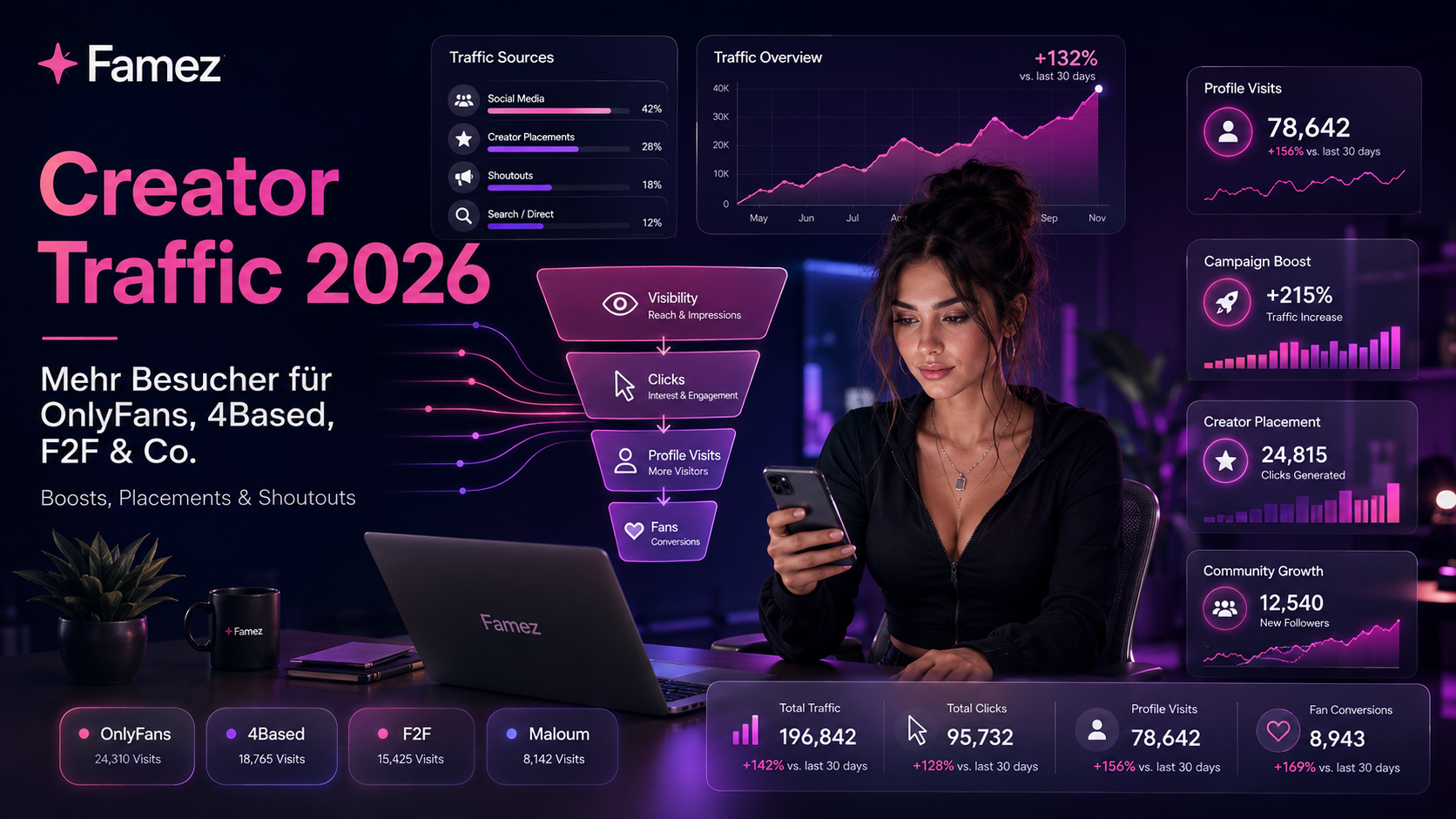
Creator Traffic 2026: Get More Visitors to OnlyFans, 4Based, F2F & More with Boosts and Placements
Great content alone is no longer enough in 2026. Creators can produce amazing photos, videos, and exclusive content, but if nobody discovers their profile, that content will not automatically generate new fans or additional sales. This is why traffic has become one of the most important foundations of a successful creator business.
-
 Sep 04, 2026
Fan Management 2026: How Successful Creators Manage Thousands of Fans at Scale
As a creator grows, the challenge is no longer just getting more fans. It is managing conversations, purchases, requests, content, and relationships at scale. This is where professional fan management becomes a major growth factor. Creators who want to build a sustainable business need structure, automation, and a clear overview of their entire community.
Featured
-
Featured Free

-
Featured Free


Comments
Sign in to leave a comment.
No comments yet. Be the first to share your opinion!